
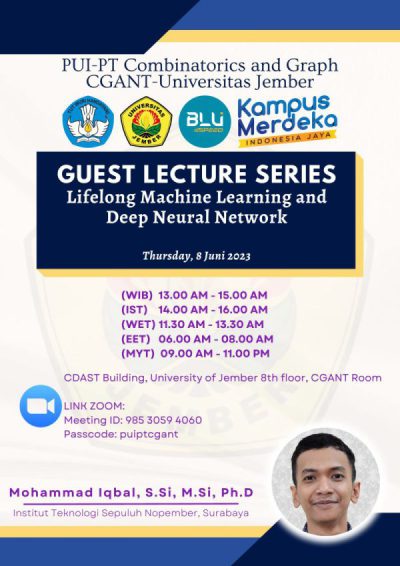

In a world that is constantly changing and rapidly developing, the ability to continuously learn and adapt is the key to success. This is also true in the context of machine learning, where the traditional paradigm that separates the training and testing stages of a model is becoming less and less relevant. The concept that emerged to overcome this challenge is lifelong machine learning. In line with this discussion, PUI-PT Combinatorics and Graph held a guest lecture with the theme lifelong machine learning and deep neural networks. Mohammad Iqbal, S.Si., M.Si., Ph.D., also attended this event as a speaker. Iqbal is a lecturer from the Mathematics Department of the Sepuluh Nopember Institute of Technology (ITS) Surabaya. Iqbal explained that Lifelong machine learning is an approach that aims to develop models that are able to continue learning all the time, assimilate new knowledge, and combine it with existing knowledge. In this case, machine learning models are not limited to a specific task or dataset, but can continuously adapt to new situations and gain additional knowledge from experience.
One popular approach to implementing lifelong machine learning is to utilize deep neural networks or deep neural networks. Deep neural networks are architectural machine learning models that consist of many layers of interconnected neurons or nodes. In this context, deep neural networks serve as a powerful framework for implementing lifelong learning, explained the man who graduated from the National Taiwan University of Science and Technology. Iqbal also added that he and his team are currently developing research on the study of Graph Neural Networks. He hopes that this guest lecture will not only add to students' insight into current trending research topics, but also to establish research collaborations with PUI-PT Combinatorics and Graph, especially in the study of Graph Neural Networks.
This webinar also available on youtube with this link: (149) Guest Lecture Series - YouTube

