

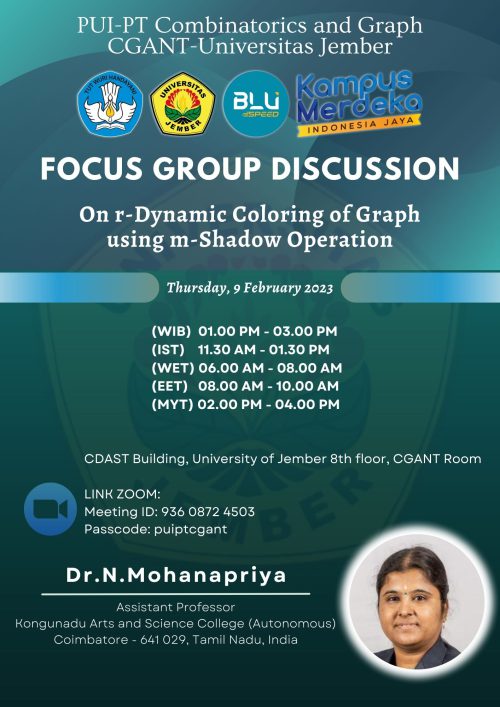

Graph theory is a branch of discrete mathematics that studies the relationship between objects that can be represented as vertices and edges of a graph. A graph consists of vertices or points connected by edges or lines, which represent the relationships or connections between these vertices. Coloring in graph theory is an important and interesting topic, which involves assigning colors to the vertices and/or edges of a graph. Vertex coloring is an important topic in graph theory which involves assigning colors to vertices in a graph with certain rules. r-dynamic coloring is one of the interesting topics in graph theory related to the coloring of vertices in a graph with certain colors. This concept involves using certain colors to color the vertices in a graph, so that each vertex has a different color and no vertex has the same color as the node directly connected to it. Apart from that, r-dynamic coloring also involves a dynamic concept, where the colors at the nodes can change over time or certain conditions change.
Continuing the discussion, Dr. Mohanapriya shared her research experience on r-dynamic coloring in this FGD (9/2). Mohana explained that basically, r-dynamic coloring is used to model a situation where there is a dependency between the vertices of a graph, in which the vertices can change their color depending on the colors used at other vertices in the graph. The application of r-dynamic coloring is mainly related to communication networks, where nodes in a graph can represent nodes or points on the network, and the colors used can represent the level or type of information exchanged between these nodes or points. Continuing Mohana's discussion, Prof. Drs. Dafik, M.Sc., Ph.D. also explained that r-dynamic coloring can be used to optimize the performance of communication networks by minimizing the amount of intervention or disruption to the flow of information between nodes or points on the network. In addition, r-dynamic coloring can also be used to model various situations that involve dependencies between nodes in a graph, such as in scheduling or production planning.

