


When looking at the globe, do you realize that neighboring countries have different colors. Of course, this coloring aims to make it easier for us to distinguish one state border from another. Then what is the minimum color needed to color the world map? Francis Guthrie, a mathematician from South Africa discovered that it takes exactly four colors to color a map of England. So that no two adjacent areas have the same color. Later, in 1852, he proposed that four colors would suffice to color each map.
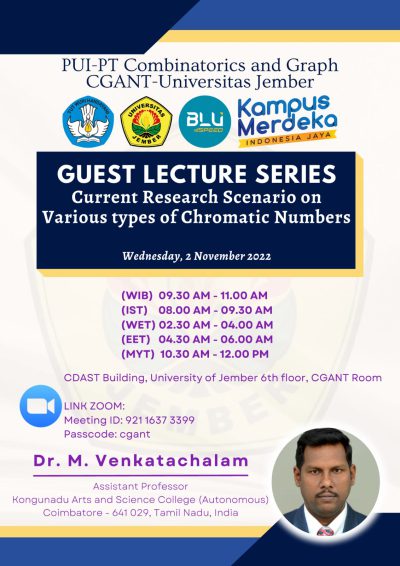
Continuing the discussion, this time PUI-PT Combinatorics and Graph held a guest lecture delivered by Dr. M. Venkatachalam. He is an Assistant Professor at Hongunadu Arts and College India. Venkatachalam explains that graph coloring is the assignment of colors to graph elements, namely vertices and edges or both. The problem of vertex coloring in graph G is the color of all vertices so that no neighboring vertices have the same color. Meanwhile, edge coloring is the assignment of colors so that no adjacent edges have the same color. The minimum number required to color the vertices and edges of a graph G is called the chromatic number.
Link youtube webinar: (318) Guest Lecturer Series: Dr. M. Venkatachalam - YouTube

